
Wide engine compatibility
Works with a wide range of DC, BLDC and AC motors, providing integration flexibility.
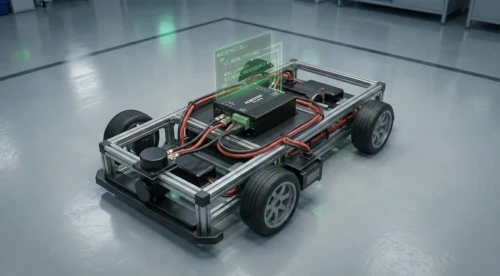
Skip the design of custom controllers and communication stacks. Nidec Roboteq provides fieldbus support, safety functions and MicroBasic logic that can replace an external PLC. This architecture shortens prototype development and makes it easier to scale the project for series production without changing the technology or rewriting the code.
Benefits
A complete feature set that speeds up integration and improves safety.
Works with a wide range of DC, BLDC and AC motors, providing integration flexibility.

Support for high-precision popular sensors and encoders: Hall, SinCos, Resolver, SSI - for optimal motion control

Intuitive MicroBasic scripting to replace PLC.

Support for communication protocols and interfaces for easy system integration: Ethernet, ProfiBUS, EtherCAT, USB, RS232, CAN.

Certified safety functions for demanding industrial and robotic applications.

A complete set of development and diagnostic tools for Windows, Linux, Android, and iOS.
Applications
Roboteq solutions support automation in robotics, industry and R&D.

self-driving carts and warehouse robots

requiring precise drive axes.

(cleaning, utility, outdoor)

building their own robotic platforms
Ready-made sets
Preconfigured drive and sensor sets for common deployment scenarios.
Integrated drive
142LDA20XROB
Controller
GBLG2660T

Integrated drive
AGV060B02
Controller
SBLG2360T

Build faster
A unified stack of drives, control, and software accelerates go-live and reduces risk.

Thanks to ready AGV kits and tools.

Dual-channel controllers, scripts instead of additional PLCs.

Industrial fieldbuses.
From a single prototype to a large robot fleet.

One supplier for the entire drive subsystem.

For larger order volumes.
Solutions
Modern motor controllers, communication protocols, and developer tools in one ecosystem.

even under heavy loads
Reduce commissioning time to hours with the integrated auto-tuning system. Advanced 16 kHz control and FOC guarantee smooth movement within the same motor footprint.

of hardware and software
Speed up R&D with ready-made ROS drivers and APIs for Linux and Windows. Connect drives to industrial networks (EtherCAT, Modbus TCP) without custom code. Flexible analog and digital I/O lets you handle full robot peripherals from one panel.

and easy scaling
Fewer controllers, fewer cables, and fast assembly with 2-channel control and ready AGV kits. Build a scalable standard using the same electronics and software whether your robot carries 50 kg or 2 tons.

for people and electronics
SIL3 / PLe compliance without extra hardware thanks to built-in STO. The controller protects the operator with intelligent current auto-protection, and a "Black Box" recorder ensures safe diagnostics of every incident.

with zero delays
Eliminate external PLCs and extra wiring by moving intelligence directly into the drive. With MicroBASIC you reduce development time and system cost, managing I/O and application logic in one compact device.
Products
From compact controllers to advanced drive systems.

Controllers for 3-phase BLDC motors with FOC, CAN/USB and STO safety options — from compact to high-current.

Controllers for brushed motors: single/dual/triple-channel, CAN/USB, from compact to high-power versions.

Controllers for AC induction motors with FOC and encoder feedback — for durable, stable operation.

Magnetic guide tape sensors (AGV) + accessories: tapes, cabling, configuration and diagnostics.

Li-Ion/LiFePO4 battery management: per-cell monitoring, active balancing, protection and regen support.

Component for 3-phase BLDC that short-circuits phases on STO, reducing braking distance.

Magnetic charging contacts for mobile robots — fast docking and constant contact pressure.

Protect the supply and controller from regen overvoltage — absorb braking energy in a resistor.

Complete drive kits (2x motor/gear/wheel + matched controller + cabling) tuned plug & play for AMR/AGV.

Integrated motor-gear-wheel assemblies (various payloads and brake variants) and frameless motors for your own mechanics.

Configuration, diagnostics, logs, simulators and drivers (ROS/ROS2) — a complete deployment toolkit.

Cabling, isolators, breakout boards and mounting accessories — faster integration and better reliability.
We specialize in Roboteq technologies. Our consultants guide you through component selection and initial tuning. You are not left alone - you receive after-sales support and access to the technical user forum.


FAQ
Roboteq is a motor controller that manages motors in mobile robots and vehicles: it controls torque, speed, braking, and direction. It typically serves as the low-level control layer between the onboard computer and the drivetrain.
Typical applications include AMR/AGV, UGV, autonomous carts, logistics platforms, and special-purpose electric vehicles. It fits where stable traction and predictable drivetrain behavior are needed in 24/7 duty cycles.
Start with the DC bus voltage (e.g., 24V/48V/60V), continuous current, and peak current required by the motor and load profile. In practice, include margin for acceleration, inclines, and start-up torque.
Depending on the series, controllers can support BLDC motors (with or without Hall sensors) and brushed DC motors. The drive technology affects smoothness, efficiency, and feedback requirements.
For applications that need stable speed and repeatability, closed-loop control with encoders or Hall sensors is used. It improves load compensation and yields more predictable acceleration and braking.
In mobile robotics the most common are CAN bus, RS232/RS485, and USB for configuration and diagnostics. Interface choice affects the control architecture (MCU/IPC/PLC) and real-time integration.
Yes. In industrial architectures the drive controller often communicates with a PLC over serial interfaces or CAN, with process logic implemented in the higher layer. Define data exchange cycles and fault handling strategies.
Many mobile applications use dual-channel configurations to control left and right drives in differential-drive or skid-steer platforms. This simplifies wiring and enables consistent ramps and current limits.
Typically you configure acceleration/braking ramps, current limits, control mode (torque/speed), and regulator parameters for feedback operation. Good tuning reduces jerks and improves traction.
During regenerative braking, energy can raise the DC bus voltage (regen overvoltage), especially with high inertia. Projects use energy absorption strategies such as a braking resistor (shunt) and appropriate protection thresholds.
Beyond drive configuration, critical elements include emergency stop (E-Stop), undervoltage/overvoltage monitoring, current protection, and correct wiring/grounding architecture. This is the foundation for safe operation in industrial environments.
Account for cooling conditions, ambient temperature, duty cycle, and current margin versus load. Stable thermals are one of the main drivers of drive controller reliability.
For maintenance, key signals are current, voltage, temperature, fault codes, and states. Integrating drive telemetry enables faster root cause analysis and reduces fleet downtime.
In selected use cases, local logic on the controller handles simple sequences and input reactions. This is useful in edge-control architectures where some decisions must occur without network latency.
Gather motor parameters, power supply voltage, target speeds and vehicle mass, gearbox type, payload mass, and required communication interfaces. This enables selection based on real peak currents and operating conditions.
Contact
We will contact you, help you choose the right solution for your project, and prepare a personalized offer.